The Bible records the history of Abraham’s family in great detail. In fact, one of Jesus’ parables reveals that Abraham represents God the Father (
Lk 16:19–24) and Abraham’s children represent God’s children (
Gal 3:7).
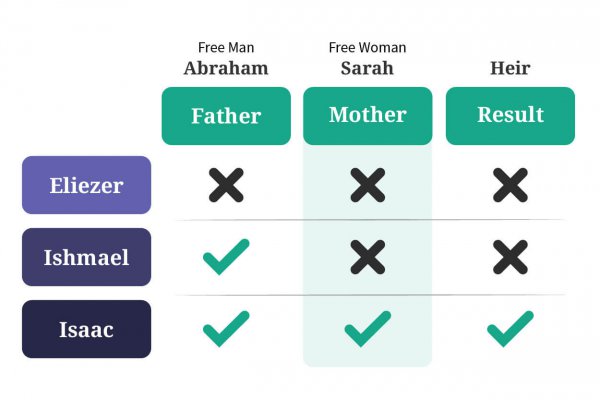
Therefore, Abraham’s family represents God’s family. And through Abraham’s family history, God teaches us the criteria for inheriting the Kingdom of Heaven. In Abraham’s family, there were three potential heirs to his estate: Eliezer, Ishmael and Isaac. Abraham tried making Eliezer, the family servant, the heir of all his wealth, but God said no. Instead, God commanded that Abraham’s heir be of his “own flesh and blood” (
Ge 15:2–4).
Since Abraham’s wife Sarah was advanced in age and could not bear any children, Abraham had a son named Ishmael by Hagar, a maidservant (Ge 16:15–16). Yet even then, God did not choose his firstborn Ishmael.
In the end, God chose Isaac to be Abraham’s heir (
Ge 17:18–19). The only difference between Isaac and Ishmael is their mother. Ishmael’s mother was a maidservant, but Isaac’s mother, Sarah, was a free woman.
Just as Abraham represents God the Father, and Isaac stands for the chosen children of God, so Sarah represents God the Mother.
Therefore, Abraham’s family represents God’s family. And through Abraham’s family history, God teaches us the criteria for inheriting the Kingdom of Heaven. In Abraham’s family, there were three potential heirs to his estate: Eliezer, Ishmael and Isaac. Abraham tried making Eliezer, the family servant, the heir of all his wealth, but God said no. Instead, God commanded that Abraham’s heir be of his “own flesh and blood” (
Ge 15:2–4).